A New Kind of Proof in Math
XQ’s Math Badging helps students master math — at their own pace
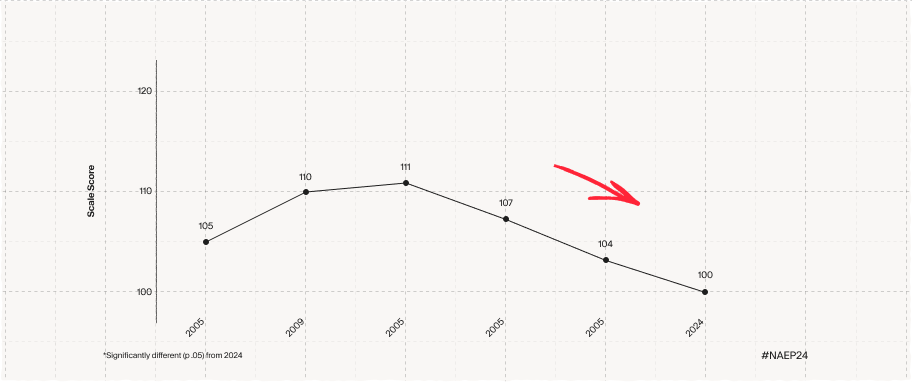
America has a math problem. Nearly half the nation’s 12th graders are failing to reach even a “basic” level of math achievement, according to the Nation’s Report Card. This reflects a decline not only from just before the pandemic; it’s the lowest achievement on record for high school seniors, going back decades. We see similarly worrisome achievement data for 4th and 8th graders.
America has a math problem. Nearly half the nation’s 12th graders are failing to reach even a “basic” level of math achievement, according to the Nation’s Report Card. This reflects a decline not only from just before the pandemic; it’s the lowest achievement on record for high school seniors, going back decades. We see similarly worrisome achievement data for 4th and 8th graders.
What’s going on? There’s no simple answer, but student disengagement, poor attendance, deficits in foundational skills, and math anxiety were the top challenges identified by math educators and school administrators.
When students were asked about their experiences in math class, many admitted to losing interest in middle and high school half or more of the time. Importantly, this RAND study also provides clues to address the problem. Students who comprehend math, enjoy the subject, feel supported, and believe in the need to learn math are most likely to maintain an interest in the subject.
At XQ, we take seriously what students and educators tell us—and what the data show. It’s clear the conventional approach to high school math is no longer working for too many young people today. It’s not working for our country, either. Employers struggle to find job candidates with the problem-solving and logical reasoning skills essential to thrive in today’s economy. The cost is real: better math skills would raise U.S. workers’ wages by an average of $21,044 a year, more than $420,000 over 20 years.
We believe it’s time to fundamentally reimagine the way high schoolers experience math. And that begins with rethinking how students learn math—particularly how what they learn connects to the real world—and how they demonstrate mastery of essential knowledge and skills.
A grade for a single Algebra or Geometry course can obscure which concepts a student understands and where they still need support. Students who fail a course may have to repeat material they have already mastered, while those who pass may move ahead with gaps in their understanding. We need ways to recognize what students have learned and help them master what they haven’t.
To address this challenge and move beyond an antiquated system, we’ve teamed up with our partners to build what we believe to be a powerful and promising solution: Math Badging.
The idea is simple: students earn badges by demonstrating mastery of defined sets of math concepts and skills. Our framework includes 23 badges covering the traditional high school math courses of Algebra 1, 2, Geometry, and the growing curricular focus on data science. These badges can be used within existing courses or combined to create different pathways toward graduation.
To earn a badge, students must show their command of the content—that is, prove they understand the math and can use it. Learning can take place through classroom instruction, independent study, special projects, summer school, or other avenues. Students who need more time can focus on the concepts they haven’t yet mastered while retaining recognition for what they already know.
We believe it’s time to fundamentally reimagine the way high schoolers experience math. And that begins with rethinking how students learn math—particularly how what they learn connects to the real world—and how they demonstrate mastery of essential knowledge and skills.
Earning a badge requires students to demonstrate both mathematical understanding and the ability to apply it in real-world situations. For example, a student with $500 saved who earns $15 an hour at a part-time job could use the linear equation y = 500 + 15x to determine how many hours they need to work to reach a savings goal. They would also have to explain what the numbers represent and how changes in their earnings or spending would affect their plan.
These opportunities to use math help students connect what they learn in school to decisions in their own lives, problems in their communities, and future studies and careers.
From Belief to Badge
Since 2015, we’ve worked with educators, schools, and communities to rethink a high school system that prioritizes “seat time” over demonstrated understanding. Math Badging puts that shift into practice by recognizing what students know and can do.
Given the stakes around math in America, we wanted to develop Math Badging to reflect the complexity of the challenge and the realities of teaching and learning today. We began by listening to state and local education leaders who saw a need for change, as well as teachers and students who could speak firsthand to what’s working—and what isn’t—in classrooms.
We then brought those perspectives to some of the nation’s leading experts in math teaching and learning to develop a new approach, and worked with high school math educators to review and pilot the resources in real classrooms.
The result is the XQ Math Badging System. This collective effort provides a powerful and promising vision to reimagine high school math in America, along with a detailed blueprint on how states, districts and schools can incorporate badging to meet their students’ needs.
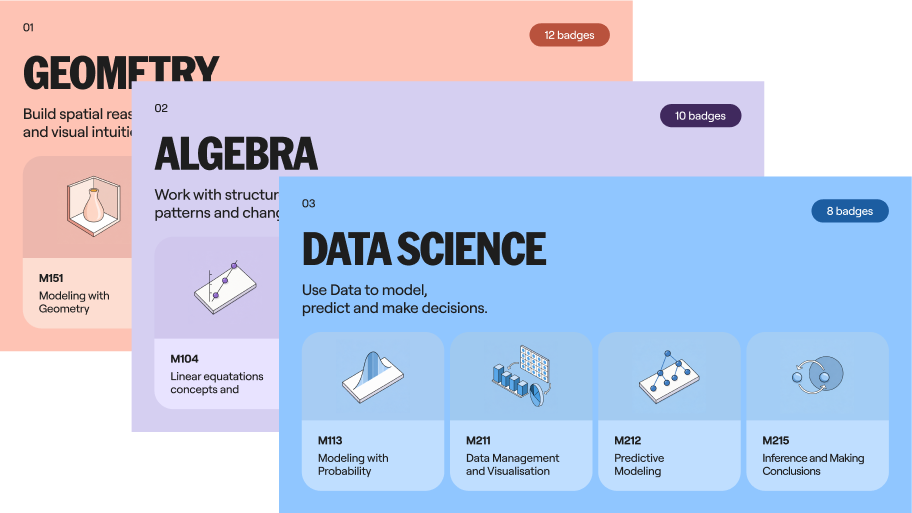
Math Badging builds on a well-established approach known as competency-based or mastery-based learning, in which students advance by demonstrating what they know and can do rather than simply completing a prescribed amount of instructional time. The system provides the architecture for any high school, district, or state to move away from the rigid, course-bound structure typical of high school math today—and has been for decades.
Each badge—bigger than a traditional academic standard but smaller than a course—provides a building block to create more flexible pathways that better connect student learning to their interests and potential futures. Stacked together, several badges could become the equivalent of completing a full math course like Algebra 1 or Geometry. Moreover, the system can be aligned with existing state standards rather than wholly replacing them.
Students earn a badge each time they prove their understanding of a key math concept and show how it applies in the real world. So, if a student struggles with quadratic equations, they don’t have to retake a year-long algebra course and earn a passing grade. They simply plug away at this one concept, with support from their teacher or even their peers, until they get it and successfully show what they know.
Badging represents a fundamental shift from the conventional approach to earning credit in high school, based on what’s known as the Carnegie Unit. Created more than a century ago, that system—which still prevails today—sets minimum instruction hours in the core subjects that students must meet to graduate. Badging gives schools clear expectations for what students need to master, along with the flexibility to build math pathways that reflect their students’ needs and goals.
We’ve worked with several states, including Idaho, Illinois, and Kentucky, to pilot math badging. These early efforts are giving us the opportunity to learn alongside the people closest to the challenge to see what works, what needs to change, and whether this approach can help more students build the math knowledge and skills they need to thrive.
A New Formula for Success
In Idaho, where we’ve been working alongside educators since 2022, state leaders saw two core challenges. Only one-third of 10th graders scored proficient or above on the state’s math assessment in 2022, and too many students were taking only the minimum math required to graduate. In addition, for students whose future plans didn’t call for Calculus, schools often offered few alternatives that were both rigorous and relevant to their goals.
Badging offered building blocks for expanding students’ high school math options. As Idaho educators put the framework into practice, schools expanded and updated their math offerings, giving students more opportunities to pursue challenging coursework connected to their interests and goals.
Badges also gave students a clearer way to see their progress. Students assemble portfolios and complete performance tasks to demonstrate their understanding and apply math to real problems. Teachers review that evidence, identify where students need support, and help them keep working toward mastery at their own pace.
Together, these changes address both what might help students persist in math and where that persistence could take them.
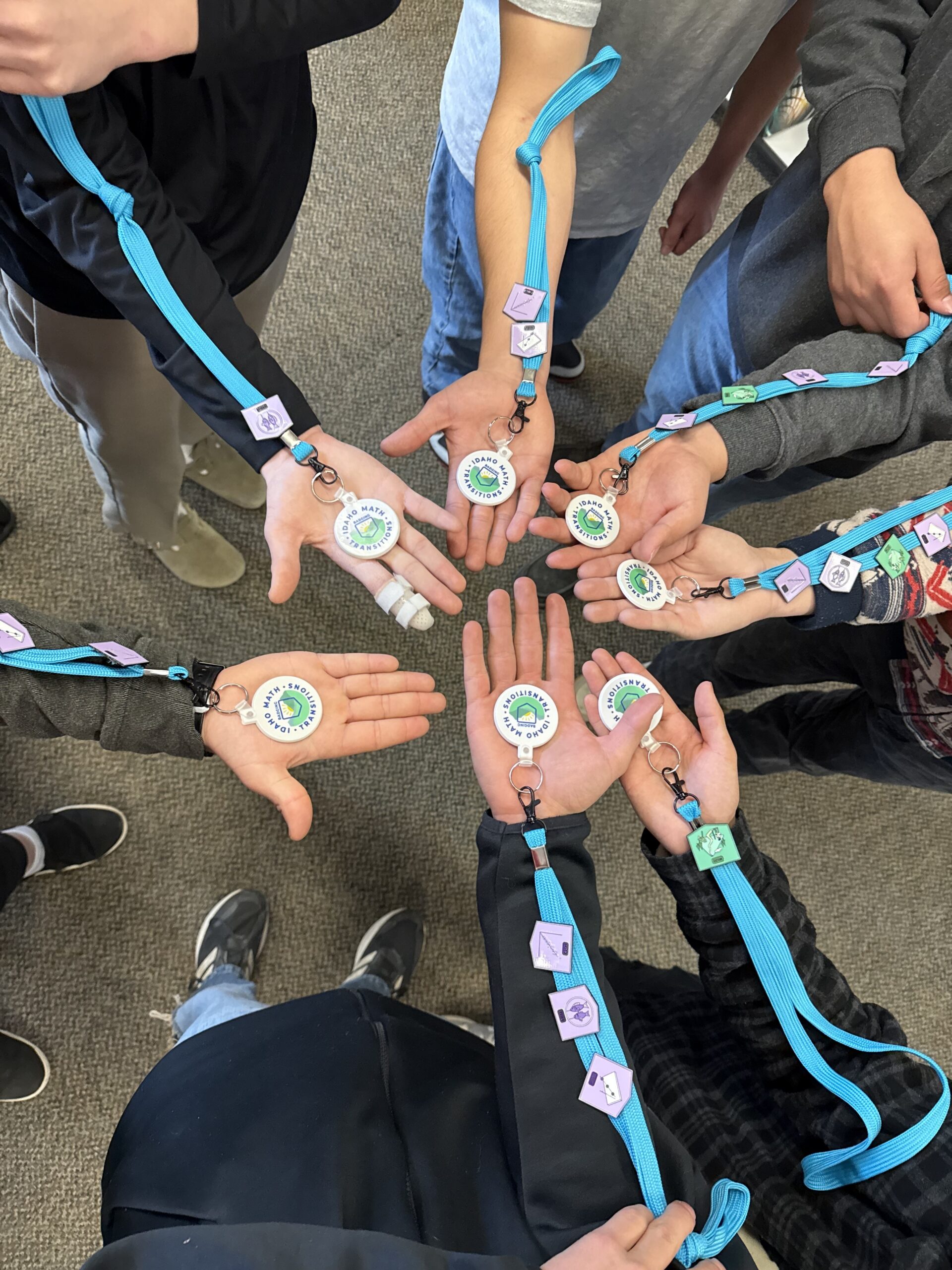
What’s exciting is what our school partners are beginning to see. Students who had “checked out” of math are becoming more engaged and confident, and more students want to continue taking math beyond the courses required to graduate.
Take Independence High School in Blackfoot, Idaho. Teacher Shelley Nash used badges to anchor student projects that bring the math to life—analyzing how the local wastewater treatment plant works, for example, and modeling traffic patterns on local roads to make them safer. For the traffic project, dubbed “Do the Math, Save a Life,” students analyzed the city’s most dangerous intersections, applying math concepts like standard deviation and two-variable data modeling. The students later presented their findings at Blackfoot City Hall to the mayor, police chief, and schools superintendent.
What’s exciting is what our school partners are beginning to see. Students who had “checked out” of math are becoming more engaged and confident, and more students want to continue taking math beyond the courses required to graduate.
Take Independence High School in Blackfoot, Idaho. Teacher Shelley Nash used badges to anchor student projects that bring the math to life—analyzing how the local wastewater treatment plant works, for example, and modeling traffic patterns on local roads to make them safer. For the traffic project, dubbed “Do the Math, Save a Life,” students analyzed the city’s most dangerous intersections, applying math concepts like standard deviation and two-variable data modeling. The students later presented their findings at Blackfoot City Hall to the mayor, police chief, and schools superintendent.
And, at another school, Rigby High, student enrollment in dual-credit math nearly tripled from 2022 to 2026, with a substantial portion of that increase coming from participation in “Math in the Modern Society,” a course supported by Math Badging.
“The goal of the Math Badging class at Rigby is to instill confidence in students who have traditionally determined math ‘isn’t for them,’” said Levi Jaynes, Administrator at Rigby. “Our Math Badging class prepares the students for math in modern society and we see more students taking dual credit math than we ever have.”
Examples like this show what becomes possible when math is treated not just as a sequence of courses, but as a way for students to understand and shape the world around them. In Idaho, badges are helping make that vision tangible—giving more students a reason to stay engaged in math, and a clearer path for taking it further.
What Counts for America’s Future
These early signs from Idaho are encouraging. But we know tackling math in America will not be a simple fix. We have much more to learn—from our partners across states and systems, in schools and classrooms, and especially from the students experiencing it firsthand.
And what we’re hearing from students is striking. “I feel more confident in math class, showing how we’re doing and growing,” one Idaho student told us. Another told us “It’s just not like a regular math class. I genuinely feel like I learn something and gain more knowledge than I would in a regular math class.” And a third student, who once counted math among their least favorite subjects, now puts it “in the top three.”
These aren’t just comments about liking a class more. They hint at what can happen when students have more opportunities to engage with math, understand what they’re learning, and see where it can take them.
“I feel more confident in math class, showing how we’re doing and growing,” one Idaho student told us. Another told us “It’s just not like a regular math class. I genuinely feel like I learn something and gain more knowledge than I would in a regular math class.” And a third student, who once counted math among their least favorite subjects, now puts it “in the top three.”
That is the promise we see in this work. Not a guarantee or a one-size-fits-all solution—but a chance to rethink some of the assumptions that have governed high school math for generations. What if students didn’t have to move through math on the same timetable? What if they could see the point of what they were learning and connect it to the world beyond school? And what if more students came out of high school believing they were capable of math?
If changing how students experience math can help more of them see themselves as capable of math and see a purpose in what they’re learning, the potential extends far beyond a transcript or a diploma.
America may have a math problem. But we’re beginning to see what’s possible when students experience math differently—when learning is relevant, progress is visible, and what they know and can do is what counts.
It’s time to change the equation.
